
Du Bois and the Clinton Church
Excerpted from Kendra T. Field's remarks on the occasion of the 154th birthday celebration of W. E. B. Du Bois, at the Mahaiwe Performing Arts Center in Great Barrington. Dr. Field, who abridged David Levering Lewis' Pulitzer Prize-winning biography of W. E. B. Du Bois, is the Du Bois Freedom Center’s inaugural historian-in-residence.
I first came to know Du Bois as a young person. Driving through the Berkshires in the ’80s and ’90s, my dad would pull off here in Great Barrington, and point out its significance to me as the homeplace of W. E. B. Du Bois. David Levering Lewis’s biography of Du Bois was the last book my father gave me before he passed, and a few years later, unbelievably, I was given the incredible gift of the opportunity to edit those same two volumes down to one.
Over the last couple of years, I received a second serendipitous gift with regard to Du Bois: the opportunity to work with the Clinton Church Restoration project (now the Du Bois Freedom Center) to create a center that interprets the life and legacy of W. E. B. Du Bois and celebrates the Berkshires’ rich African American heritage. Located at the restored Clinton A. M. E. Zion Church, for me this work is about deepening public understanding of the Black families, Black communities, and indeed Black institutions that shaped Du Bois’ early life. I’d like to share with you a bit about why this particular work and perspective matters.
Following his mother’s death at fifty-four, William Edward Burghardt Du Bois boarded the train south to Fisk University, the first African American institution of higher education to emerge after emancipation and the emerging sacred heart of the black world. In a matter of days, William went from being the sole black student in his school to being awestruck, he wrote his former Congregational pastor in a letter his freshman year, "to know that I stand among those who do not despise me for my color." At Fisk, for the first time, William came face to face with the immediate aftermath of slavery. His new classmates were members of freedom's first generation, enslaved as babies or toddlers amidst the Civil War.
“It is just so easy to talk about the white community’s significance to William’s development… It is much harder and yet all the more necessary to rescue from relative oblivion the quieter evidence of Du Bois’ immersion in Black family and kin networks, Black communities, institutional life, and spiritual traditions…”
Before closing his letter, having gleefully detailed his newfound Black community, he added “yet I have not forgotten to love my New England hills…” And while Du Bois’ exposure to the Fisk Jubilee Singers stirred feelings of reverence, pride and belonging in sixteen-year-old William in Nashville, his first hearing of many of these songs was right here in Great Barrington. “Ever since I was a child these songs have stirred me strangely,” he recalled. “They came out of the South unknown to me, one by one, and yet at once I knew them as of me and of mine.” Indeed, Fisk was not his first introduction to the spirituals. During his high school years, while tending to his mother’s failing health, mother and son attended some services of the A. M. E. Zion Society. Unlike their involvement in the Congregational Church, these services took place in members’ homes. The group had grown significantly in the two decades since southern emancipation, and many of its members were freed people from the southern states. They, in turn, introduced a young William Du Bois to spirituals and African American song.
Du Bois’ relationships with white ministers like Rev. Scudder, teachers and principals like Frank Hosmer, and the white community more broadly left behind ample paper trails, from well-preserved letters to tuition checks. It is just so easy to talk about their significance to William’s development, to the family’s survival during his mother’s illness, to his enrollment at Fisk. It is much harder — and yet all the more necessary — to rescue from relative oblivion the quieter evidence of Du Bois’ immersion in Black family and kin networks, Black communities, institutional life, and spiritual traditions reflected in the work, for instance, of the Clinton A. M. E. Zion church society of his youth.
It was Rev. Esther Dozier, the first woman pastor at Clinton, who in fact initiated the tradition of celebrating Du Bois’ birthday at Clinton Church two decades ago, at a time when yet few acknowledged his significance here. As writers, teachers, museum workers, activists, residents, and descendants, we must do better, and work harder, to illuminate these rich, yet hidden histories, the countless stories told behind closed doors. As E. Frances White has written, “The stories we refuse to tell… do matter.”
Partial transcript of Du Bois’ October 18, 1884 column for the New York Observer (pictured): “The trustees of the A.M.E. Zion Church have succeeded in making an advantageous exchange of land for the site of the church with Dr. Samuel Camp. The piece has a fine situation on Elm [S]treet, in the heart of the town.”

W. E. B. Du Bois as a young man | photo: New York Public Library

Du Bois with his Great Barrington High School Class, 1884 | photo: New York Public Library

Text of 1884 newspaper column about the A. M. E. Zion Church, written by Du Bois for the New York Globe
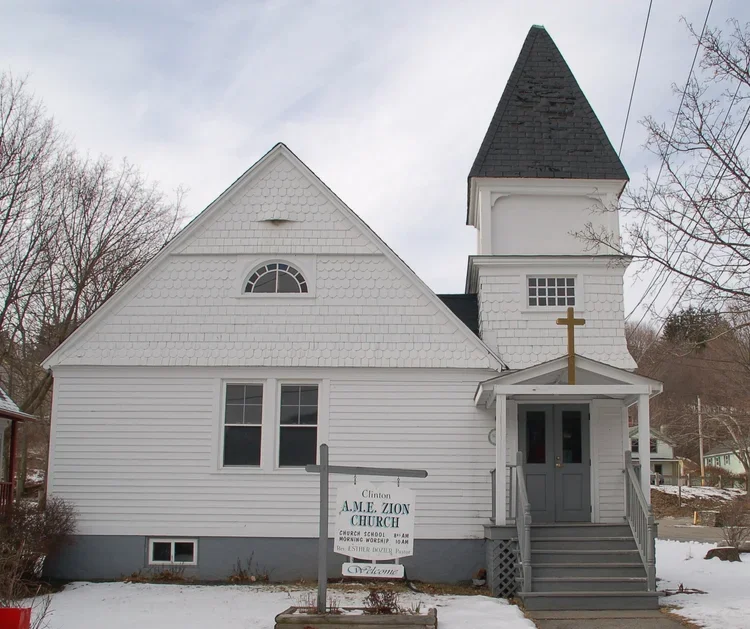
Clinton A. M. E. Zion Church, 2007 | photo: Rachel Fletcher
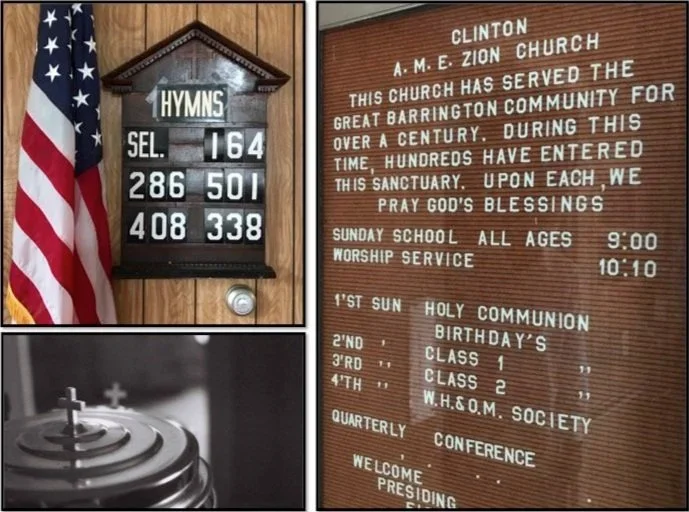
photos by Julie McCarthy
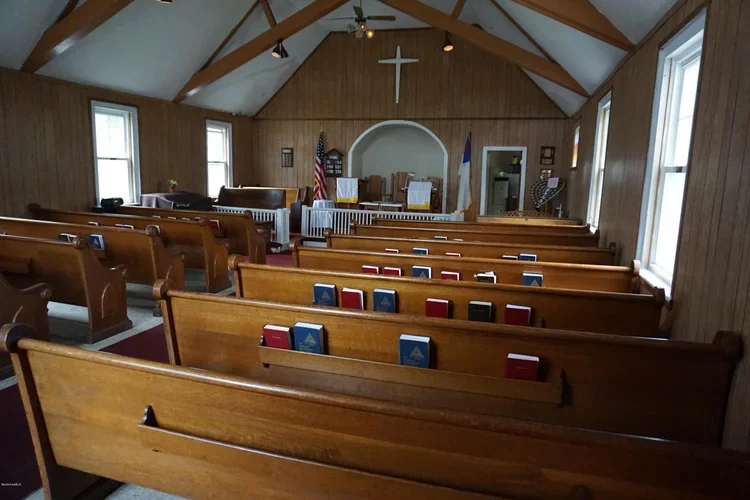
Clinton A. M. E. Zion Church
The Clinton A. M. E. Zion Church in Great Barrington was the spiritual, cultural, and political heart of Black life in the region for nearly 130 years. The A. M. E. Zion Society that built the church in 1886, was a formative influence in the life of W. E. B. Du Bois, the pioneering author, intellectual, and NAACP co-founder who was born and raised in this small, rural town.
The most enduring African American church in Berkshire County, the Clinton Church was more than a place of worship. The Sewing and Literary Societies hosted public readings, plays, debates, concerts, and guest speakers. The Children’s Mite Society offered music, rhetoric, and public speaking classes not otherwise available to Black students at the time. The church was also the focal point for social and political activism, driven first by the segregation and violence of the Jim Crow era and continuing into the 1950s and 1960s when it hosted the Berkshire County chapter of the NAACP, early meetings of the housing agency Construct, and United Church Women, an ecumenical organization devoted to human rights, peace, and justice.
“The Clinton Church was my church home from childhood to adulthood. Within its walls, my moral values and sense of community were nurtured.”
Everett Brinson, b. 1938, Great Barrington
The Clinton Church’s history of advocacy for racial justice has been well-documented in David Levinson’s book, The African American Community in Rural New England: W.E.B. Du Bois and the Clinton A.M.E. Zion Church.
In the fall of 1895, the Church hosted the New England Conference of the A. M. E. Zion Church’s annual Sunday School convention. Dozens of pastors and teachers attended the event, where grave concerns about lynching and the treatment of Black people were expressed.
The Berkshire County NAACP Chapter, formed in 1918 and reactivated in 1945, met in the Church’s basement throughout the 1950s and ’60s. Pastors and congregants complained publicly about housing discrimination, harassment and police brutality against Black youth in Great Barrington, advocacy that led to the establishment of a town-wide committee on police relations in 1969.
Rev. Esther Dozier, who became the church’s first female pastor in 1999, was equally outspoken on matters of injustice. Under her leadership, the Church promoted Black history and the life and legacy of W. E. B. Du Bois, who had been largely ignored in his hometown for decades. While the church first became publicly involved in honoring Du Bois in 1994, when historical markers were dedicated at the site of his birth and the cemetery where his first wife and infant son were buried, it was Dozier who initiated the town’s annual celebrations of Du Bois that continue today.
The shingle-style church is also historically and architecturally significant for its association with the religious and cultural heritage of African Americans in rural New England and as a distinctive example of 19th-century vernacular church architecture. A key site on the Upper Housatonic Valley African American Heritage Trail, it was added to the National Register of Historic Places in 2008. The church closed its doors in 2014.